Feature
Turtles & Time — A 200-Million-Year Design
Turtles predate the dinosaurs' golden age and attended their funeral. Meet the most time-proof vertebrate on Earth.
Senior to the dinosaurs
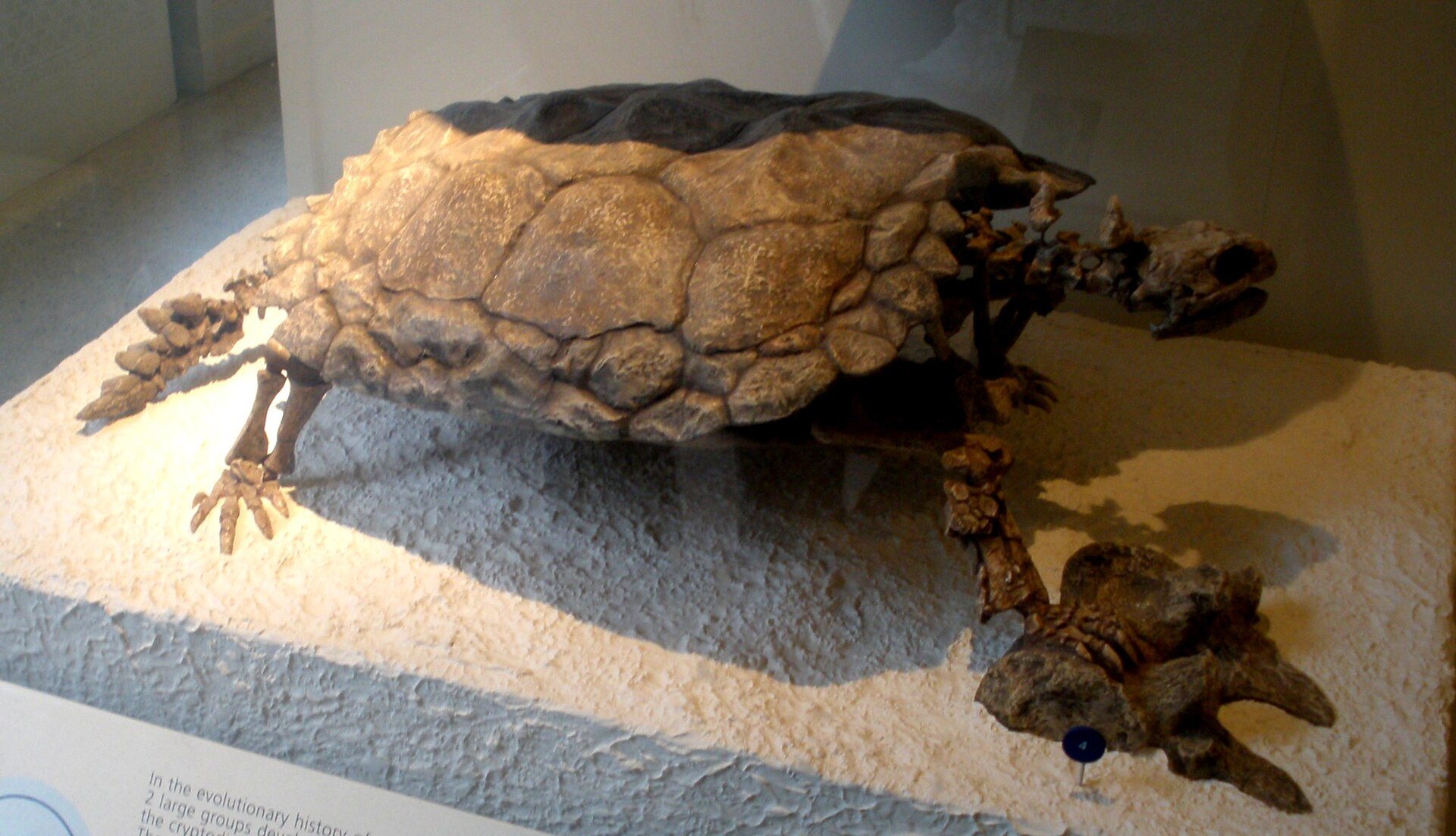
Proganochelys, one of the oldest known turtles, lived about 210 million years ago in the Late Triassic — more than 100 million years before T. rex. A shelled turtle was already walking the Earth.
And it looked astonishingly like turtles today. It couldn't retract its neck, but the fundamental design was finished. Turtles got it almost right the first time.
How the shell was built
Odontochelys, discovered in China in 2008 and dating to ~220 million years ago, caught evolution mid-stride: it had only a belly shell, and it still had teeth. The shell was completed from the underside first.
The unprecedented blueprint — ribs and spine flattened into armor (see Secrets of the Shell) — then went essentially unchanged for 200 million years. It didn't need changing.
Surviving the ends of the world
Turtle history overlaps every mass extinction since the Triassic — including the asteroid that ended the dinosaurs 66 million years ago. Turtles made it through. Living near water, running a slow metabolism, able to skip meals for months: in apocalyptic times, 'slow' is the ultimate survival strategy.
The very trait we tease turtles for turns out to be a 200-million-year winning move. The tortoise beat the hare on geological timescales, too.
And now, the worst crisis yet
Asteroids and ice ages couldn't stop turtles — but the present may be the most dangerous moment of their 200 million years. Roughly half of living turtle species are considered threatened, by overharvesting, habitat loss and climate change. In other words, by us.
A lineage that outlived the dinosaurs shouldn't end on our watch. The red tags in this encyclopedia mark exactly where things stand.