Dictionary of Turtle Words
Proverbs, idioms, everyday words born from turtles, and turtle expressions from around the world. Japanese contains more turtle than you think.
Proverbs & Idioms
- 鶴は千年、亀は万年Tsuru wa sennen, kame wa mannen
- "Cranes live a thousand years, turtles ten thousand." The definitive Japanese blessing of longevity — the reason cranes and turtles appear together on wedding kimono and celebratory gifts.
- 亀の甲より年の功Kame no kō yori toshi no kō
- "Better the merit of years than the shell of a turtle." A pun on kō (shell/merit): even a ten-thousand-year turtle shell bows to the value of lived experience.
- 月とすっぽんTsuki to suppon
- "The moon and the soft-shelled turtle" — both are round, yet worlds apart. The Japanese way of saying two things are beyond comparison. The poor suppon is a perfectly good turtle, but it lost the beauty contest to the moon.
- うさぎとかめThe Tortoise and the Hare
- Aesop's fable is a childhood staple in Japan too, complete with its own beloved children's song ("Moshi moshi kame yo"). Slow and steady wins the race — the turtle's global motto.
- 亀の年を鶴が羨むKame no toshi o tsuru ga urayamu
- "The thousand-year crane envies the turtle its ten thousand." However blessed you are, someone always seems to have more — a proverb about the boundlessness of envy.
- 盲亀の浮木Mōki no fuboku
- "The blind turtle and the driftwood": a Buddhist parable of a blind turtle that surfaces once a century and happens to put its head through a hole in a floating log — the astronomical odds of being born human and encountering the dharma. Now used for any once-in-a-lifetime stroke of luck.
- 亀鳴くKame naku
- "The turtle sings" — an official spring season-word in haiku. Turtles do not, in fact, sing. Japanese poetry simply decided that an imaginary turtle song was the perfect expression of a drowsy spring day.
Everyday Words Born from Turtles
- 亀裂Kiretsu
- The everyday word for "crack" is written 亀裂 — literally "turtle split," likening fissures to the crack-like pattern of a turtle's shell. Behind it lies plastromancy (kiboku): the ancient practice of scorching turtle shells and reading fortunes in the cracks, which helped give the character for turtle its secondary meaning of "fissure."
- 亀甲Kikkō
- The hexagonal "turtle shell" motif, used on textiles and crafts since the age of the Shosoin treasury (8th century). In Japan, virtually anything hexagonal gets called kikkō — including the pattern hidden in Kamepedia's logo.
- 亀の子たわしKamenoko tawashi
- The "baby turtle scrubbing brush," born in 1907 and still a registered trademark. Named for its resemblance to a turtle hatchling, this little turtle has been swimming through Japanese kitchens for over a century.
- ゼニガメZenigame
- "Coin turtle" — the Edo-period nickname for Japanese pond turtle hatchlings, whose little shells resembled old coins. They were kept as charms for good fortune, and the name survives to this day.
Tales & Legends
- 浦島太郎Urashima Tarō
- Japan's most famous folktale: Urashima Tarō rescues a bullied turtle and is carried to the Dragon Palace beneath the sea. The turtle as a guide between worlds appears in legends all across Japan — though the story's ending, involving a mysterious box, is famously bittersweet.
- 玄武Genbu
- The Black Tortoise, guardian deity of the north — depicted as a turtle entwined with a snake. It appears in the 7th–8th century murals of the Kitora Tomb in Nara, and lives on in place names and shrines across Japan.
Turtle Words of the World
- slow and steady wins the raceslow and steady wins the race
- The English moral of the Tortoise and the Hare. In the anglophone world, the turtle is the patron animal of steady, unglamorous effort.
- turtles all the way downturtles all the way down
- "The world rests on a giant turtle." "Then what does the turtle stand on?" "It's turtles all the way down." The famous retort mocking infinite regress, beloved by philosophers and cosmologists alike.
- come out of one's shellcome out of one's shell
- To stop being shy and open up. In English idiom, every wallflower is secretly a small turtle.
- SchildkröteSchildkröte (German)
- German for turtle — literally "shield toad." A wonderfully blunt bit of naming: a toad carrying a shield.
- 龟 / 거북선Guī (Chinese) / Geobukseon (Korean)
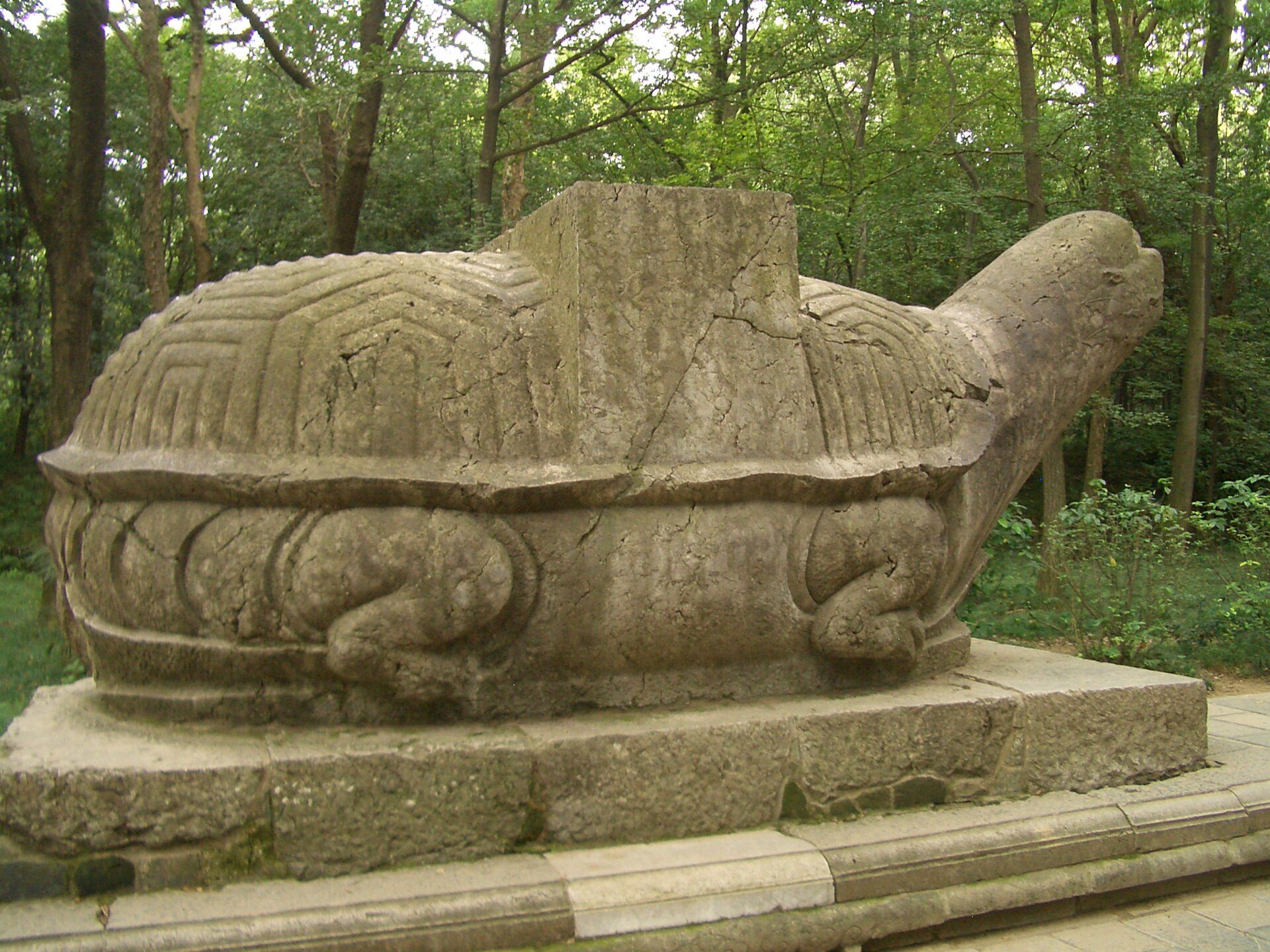
- In classical China the turtle ranked with the dragon and phoenix as an auspicious beast, carrying stone steles on its back — though in modern slang the character has picked up a second, ruder life. In Korea, the Geobukseon ("turtle ship") was admiral Yi Sun-sin's armored warship of the 1590s, history's most famous turtle-shaped vessel.