Feature
Turtles & Myth — The Ones Who Carry the World
The world in India, the sky in China, the land in North America. Wherever humans imagined something too heavy to hold, they handed it to a turtle.
The world on a shell — India
In Hindu myth, Vishnu takes the form of the great turtle Kurma during the Churning of the Ocean of Milk, bearing Mount Mandara on his back so it will not sink. The heaviest job in the universe went to a turtle.
The image of a world resting on a turtle spread far beyond India — eventually becoming the punchline of the philosophy joke 'turtles all the way down' (see our Dictionary of Turtle Words).
Holding up the sky — China
In Chinese creation myth, when the pillars of heaven broke, the goddess Nüwa cut the four legs of the great turtle Ao and used them to prop up the corners of the sky. Again the turtle takes the weight of the world.
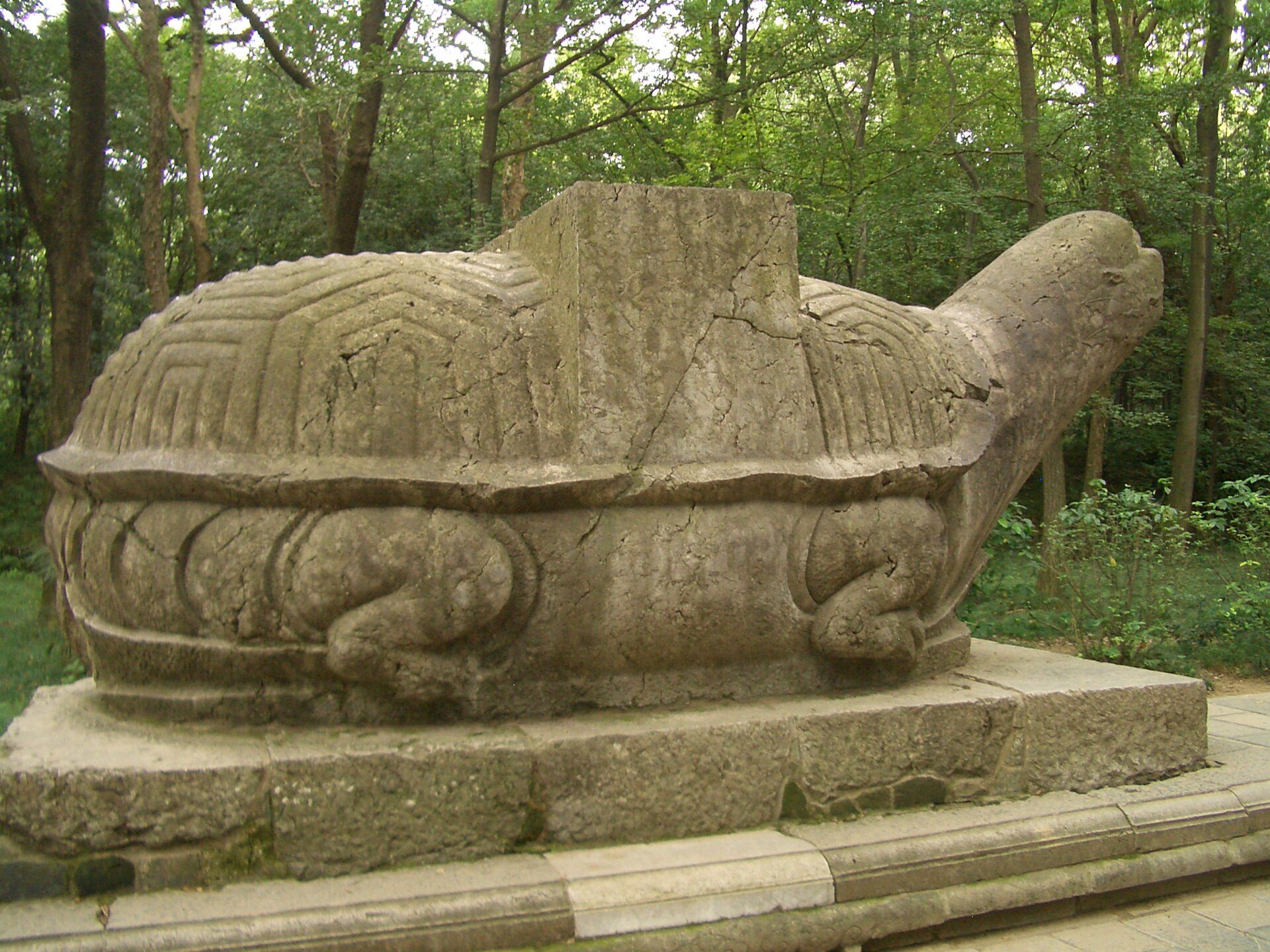
Add Genbu the northern guardian, plastromancy, and the stone turtles that carry steles on their backs. That stele-bearer is called Bixi — written with the same characters as the Japanese word hiiki, 'to favor someone.' One theory says the turtle who gladly bears burdens gave its name to the act of shouldering someone's cause.
Guide to the world beyond the sea — Japan
Japan's mythic turtles carry people rather than worlds. Urashima Tarō's turtle ferries the young man who saved it to the Dragon Palace beneath the sea — a story whose roots reach the Man'yōshū and the eighth-century Tango Fudoki, making it one of Japan's oldest fantasies.
Add the turtle bearing Mt. Hōrai, isle of the immortals, and the 'ten thousand years' of longevity lore — Japanese turtle myth is a story of paradises across the sea and of deep time (see our essay).
The land itself — North America
Many Indigenous nations of North America tell of the earth being built on a great turtle's back: animals diving to bring up mud from the primordial sea and placing it on the shell, where it grew into land.
From this myth, the continent itself is still called Turtle Island. For many Indigenous peoples the turtle is not a character in a story — it is the ground beneath their feet.
Guardian honu — Polynesia
Across Polynesia the sea turtle is a being apart. In Hawaii, some families honor the honu as an ʻaumakua — an ancestral guardian spirit — and turtles appear carved into ancient petroglyphs.
For a navigator people who crossed the Pacific by the stars, an animal that crosses oceans and returns unerringly to its birth island may have been the highest compliment the sea could offer.
The turtle who became a lyre — Greece
In Greek myth, newborn Hermes strung a turtle shell and invented the first lyre — a turtle sits at the origin story of Western music.
One more for the road: the playwright Aeschylus is said to have died when an eagle dropped a tortoise on his head. Carrying worlds, becoming instruments, occasionally serving as projectiles — mythological turtles keep remarkably busy.